Stage 02 · The database core
Cassandra and DynamoDB
You’re storing chat messages. The only queries are “the latest 50 in chat 42” and “the 50 before this one”. You never join. You need a million writes a second, and you’d rather serve a slightly stale read than reject a write during a failover.
That workload is almost exactly what wide-column stores are built for. Cassandra (open source) and DynamoDB (managed) share the same central idea: you design the table around the query, and the database spreads partitions across many machines with no leader.
Partition key and clustering key
Every table has a primary key in two parts.
CREATE TABLE messages (
  chat_id    bigint,
  created_ts timestamp,
  message_id uuid,
  sender_id  bigint,
  content    text,
  PRIMARY KEY ((chat_id), created_ts, message_id)
) WITH CLUSTERING ORDER BY (created_ts DESC, message_id ASC);
(chat_id) is the partition key. It’s hashed to pick which nodes hold the row, so all of chat 42 lives on one replica set. created_ts, message_id are clustering keys: rows within a partition are stored physically sorted by them.
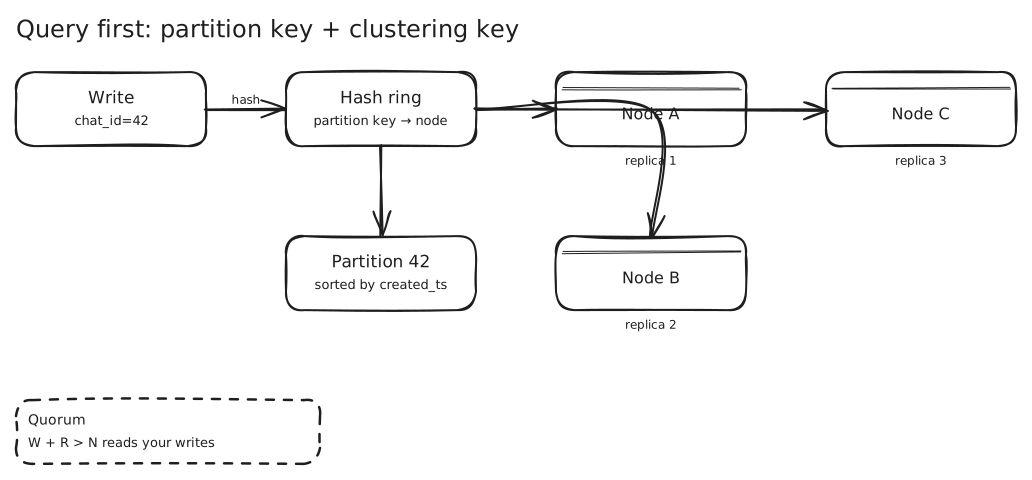
“Latest 50” reads the front of one sorted run on one node. “The 50 before X” is a seek and a sequential read. No index, no sort, no scatter. The data is already in the order the screen wants. DynamoDB calls the same pair the partition key and sort key.
Query first. In SQL you model the data, then write queries. Here you list your queries, then build a table for each. If you need messages by user and by chat, you keep two tables and write to both (or derive one from the other). Denormalisation is expected. → Normalization and Denormalization · Secondary Indexes at Scale
No leader, tunable consistency
Data is placed on a hash ring (consistent hashing) and replicated to N nodes (usually 3). Any replica can accept a write, so there’s no failover gap. → Consistent Hashing
You choose consistency per operation. With R + W > N (say quorum reads and writes with N=3, so W=2 and R=2), a read overlaps the latest write, giving read-your-writes without anyone being in charge. Lower it (ONE) for speed and staleness. This is the AP end of CAP Theorem: available under partition, eventually consistent otherwise. → PACELC Theorem
The cost: there’s no single place to decide “version 5 is taken”. A unique-insert or “book this seat” check needs a conditional write (Cassandra lightweight transactions, DynamoDB conditional writes) or a different store. → Transactions and Isolation
Why writes are cheap: the LSM tree
Cassandra writes to an in-memory memtable and an append-only commit log, then flushes the memtable to an immutable SSTable on disk. Writes are sequential appends. Reads may check the memtable and several SSTables (Bloom filters help skip files), and background compaction merges them.
Deletes write a tombstone marker, which sticks around until compaction and a grace period pass. Deleting lots of rows, or queuing patterns (write, read, delete), leave piles of tombstones that slow reads. This is a classic Cassandra trap.
Hot and huge partitions
The partition is the unit of placement, so a bad key ruins the design.
- Hot partition: one key takes most traffic (a celebrity, a viral ad). Every request hits one replica set. Fix with a suffix or salt (
adId#0..15) and merge on read. → Hotspots and Dynamic Resharding - Unbounded partition: a busy chat grows forever (Discord saw partitions past 100 MB cause GC pauses). Add a time bucket to the partition key:
PRIMARY KEY ((chat_id, bucket), created_ts, …)withbucket = created_ts / 10 days. Each chat is a series of bounded partitions. - Scatter queries: a query without the partition key touches every node. Don’t build access patterns that need it.
DynamoDB specifics
- Capacity per partition: roughly 1,000 write units and 3,000 read units per second per partition (a 1 MB/s write ceiling). A hot key throttles no matter how much you provision. On-demand mode and adaptive capacity smooth the average, not one hot key.
- Secondary indexes: a GSI has its own partition key and is eventually consistent; an LSI shares the table’s partition key and is local. → Secondary Indexes at Scale
- Conditional writes (
attribute_not_exists) give you the atomic check-and-set you need for dedup and claims. Transactions exist but cost more. - TTL deletes expired items for free. Streams emit changes for CDC.
- Single-table design puts several entity types in one table under overloaded keys to serve a query in one read. It’s powerful and hard to change later.
When to choose it
Pick a wide-column store for massive write volume, simple key-based access, known queries and a preference for availability: messages, feeds, time series, sessions, activity logs. Don’t pick it for ad-hoc queries, joins or multi-row transactions. A relational database with good indexes serves far more workloads than people expect. → SQL vs NoSQL
In an interview
Name the partition key and the clustering key and say which query each serves. Then say what stops a partition getting hot or unbounded. Say what consistency you read and write at, and what you’d lose with a leader instead.
The trap is “use NoSQL for scale” with no key, no queries and no consistency story.
Seen in
- Chat System — messages by
chatIdsorted by time, the time-bucket fix, and the per-user inbox - News Feed —
Posts,Feedand follower tables; why no leader mattered - Google Drive —
IncomingFileChunksand a per-user change journal - YouTube — video metadata as a point lookup by id
- Yelp — location history for Nearby Friends
Related
NoSQL Databases · Databases and DBMS · Replication and Read Consistency