Stage 07 · Async and messaging
Durable Execution and Sagas
An order needs five steps: reserve stock, charge the card, book shipping, send the email, update loyalty points. Each step calls a different service. Something will fail halfway, and the worker running the sequence will sometimes die. Where does the “what step am I on?” live?
If it lives in the worker’s memory, a crash loses it, and you get a half-finished order with nobody responsible. This is a multi-step process, and the standard answers are a saga for the logic and durable execution for the machinery.
Why not a transaction?
Inside one database, BEGIN ... COMMIT makes the five steps atomic. Across five services and a payment provider there is no such thing. A bank won’t hold a prepared transaction open for you, and two-phase commit puts a coordinator on the critical path, holds locks, and blocks everyone if it dies. → Avoiding Distributed Transactions
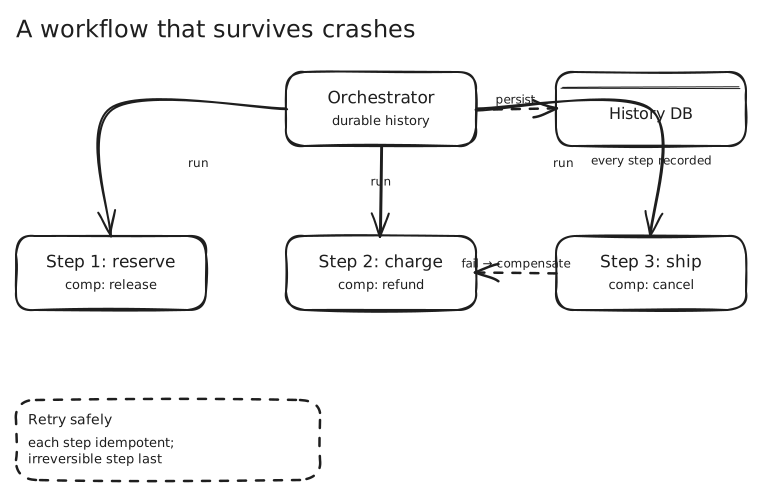
A saga replaces atomicity with compensation: a sequence of local steps, each committing on its own, each with a compensating action that offsets it if a later step fails.
1. reserve stock      compensate: release stock
2. charge card        compensate: refund
3. book shipping      compensate: cancel booking
4. send email         compensate: none (you can't unsend)
Rules that make sagas work:
- Compensation isn’t rollback. A refund is a real new transaction that appears on the customer’s statement next to the charge. Both events happened.
- Put the irreversible step last. You can un-reserve stock, but not un-send an email.
- Sagas have no isolation. Between steps 2 and 3, the order is visibly half-done. The UI needs a word for it (“Processing”).
- Every step and every compensation must be idempotent, because retries will repeat them. → Idempotency
Orchestration or choreography
Choreography: each service reacts to events and emits its own. No central controller. It’s decoupled, and the overall flow is hard to see, test or change.
Orchestration: one orchestrator knows the whole flow, calls each step, tracks state and triggers compensations. The flow is explicit and observable. The orchestrator becomes a component you must keep highly available. → Orchestration and Choreography
For flows with many steps, timeouts and retries, orchestration usually wins.
Durable execution: workflow code that can’t lose its place
Writing an orchestrator by hand means persisting state after every step, resuming after crashes, scheduling timers and retrying with backoff. Engines like Temporal (and AWS Step Functions, Azure Durable Functions) do that for you.
You write the workflow as ordinary code:
def order_workflow(order):
    reserve(order)                      # activity
    try:
        charge(order)
        ship(order)
    except Failure:
        release(order)                  # compensation
        raise
    send_email(order)
The engine records every step’s result in a durable history. If the worker dies mid-workflow, another worker replays the history to rebuild the exact position and continues. Completed steps aren’t re-run; their recorded results are reused. Timers (sleep(3 days)) survive restarts, and retries follow a policy you declare (exponential backoff, maximum attempts).
Two rules the code must follow:
- Workflow code must be deterministic (no random numbers, no wall-clock reads, no direct I/O), because it’s replayed. Side effects go in activities.
- Activities must be idempotent, because “ran but the acknowledgement was lost” means they may run again.
When to reach for it
- Long-running processes: video transcoding DAGs, onboarding flows, payments, deployments, anything measured in minutes to days. → Long-Running Tasks
- Anything with timers: “cancel the order if unpaid in 30 minutes”.
- Human steps: wait for an approval signal.
- Fan-out and fan-in with retries: a transcode of 1,500 segment tasks, then assemble.
You don’t need it for a two-step flow that can be an outbox row and an idempotent consumer. A queue with retries plus a status column covers a lot.
The write you must get right: the outbox
A common step is “update the database and publish an event”. With two systems and no shared transaction, either order can leave them disagreeing. Write both in one local transaction: the state change and an outbox row. A relay publishes outbox rows to the broker at-least-once. → Event-Driven Architecture · Kafka
BEGIN;
  UPDATE payments SET state='SUCCESS' WHERE id=? AND state='SENT';
  INSERT INTO outbox(topic, payload) VALUES ('payment.succeeded', ?);
COMMIT;
In an interview
Say “saga with compensations, irreversible step last, every step idempotent”, then whether you orchestrate (usually) and what stores the state (a durable workflow engine, or a state column plus a sweeper). Say what happens if the orchestrator dies: it resumes from durable history.
The trap is proposing two-phase commit across services, or a saga with no compensation for the step that can fail.
Seen in
- YouTube — the transcoding DAG on a workflow engine, idempotent tasks by deterministic key
- Google Pay — the payment saga, reversal versus rollback, outbox
- BookMyShow — payment plus booking with a reconciler instead of 2PC
- Uber — a durable workflow for the “offer, wait, retry” matching loop
- Notification System — scheduled sends and retry topics
- Job Scheduler — durable timers and at-least-once execution
- Robinhood — order lifecycle across broker and exchange
Related
Avoiding Distributed Transactions · Idempotency · Orchestration and Choreography · Event Sourcing