Stage 07 · Async and messaging
Long-Running Tasks
A user uploads a two-hour video and clicks “publish”. Transcoding takes forty minutes. If your API holds the HTTP request open, the request times out, a deploy kills the worker, and the user stares at a spinner. Some work simply takes longer than a request, and the design has to say so.
The pattern is the same whether it’s transcoding, report generation, a bulk email, an import, an ML training run or a crawl: accept quickly, do the work elsewhere, and let the caller ask about progress.
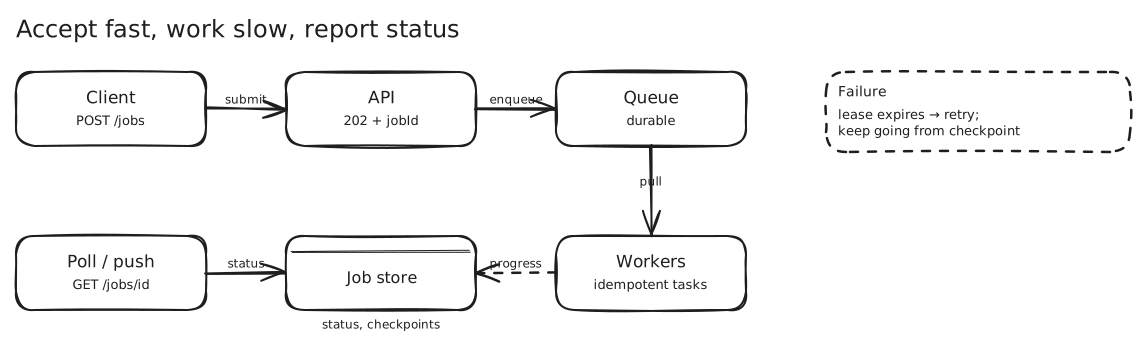
The shape
- Accept and acknowledge fast. The API validates the request, writes a job row (
jobId, statusPENDING, input), enqueues it, and returns202 Acceptedwith thejobId. - Work asynchronously. Workers pull from a durable queue and run the job.
- Report status. The caller polls
GET /jobs/{id}(or receives a webhook or a push over SSE/WebSocket). The row movesPENDING → RUNNING → SUCCEEDED / FAILED. - Make the result retrievable. Store outputs somewhere durable (object storage) and return a pointer. → Handling Large Blobs
Idempotent submit: accept a client-supplied idempotency key so a retried submit returns the existing job, not a second one. → Idempotency
Workers die; jobs shouldn’t
Workers crash, get preempted and get redeployed. Three habits keep the job alive.
- At-least-once delivery. If a worker doesn’t finish, the queue redelivers. Use a visibility timeout or lease: a claimed job is invisible for N seconds and returns to the queue if not completed or renewed. → Message Queues
- Heartbeats. A long task renews its lease. If heartbeats stop, the job is reclaimed. (Set the lease longer than a normal heartbeat gap, or a slow worker causes duplicate execution.)
- Idempotent execution. Since a job may run twice, each step must be safe to repeat. Make outputs a pure function of the task (
videoId/720p/seg_00042), so a retry or a slow duplicate writes the same bytes to the same key.
Break it into tasks
One monolithic job is slow (it can’t use more machines), loses everything on failure, and shows a single status: “running”.
Split it into many small independent tasks: cut a video at keyframes into segments, each an independent encode; page a crawl into per-host queues; shard a report by date range. Now you can:
- Parallelise across the fleet.
- Retry just the failed piece (one four-second segment, not two hours).
- Show progress (1,240 of 1,500 segments done).
- Speculate on stragglers (launch a duplicate of the slowest task, take whichever finishes first; safe because tasks are idempotent).
Some steps depend on others, so the tasks form a DAG: inspect → split → fan out → fan in (assemble) → manifest → mark READY. Write the outputs first and the pointer last. → YouTube
Checkpoint, so a restart resumes
A single long-running step (a crawl, a training run, a big import) should periodically save enough state to continue: a cursor, an offset, a snapshot. After a crash it loads the latest checkpoint instead of starting over. Make sure the snapshot is consistent across the pieces of state that must agree, or you lose or double-process items. → Web Crawler
Who tracks the plan: a workflow engine
Hand-rolled orchestration (a status table, a sweeper, timers) works for simple cases. When you have many steps, retries with backoff, timers (“cancel if unpaid in 30 minutes”), human approvals or compensations, use a durable workflow engine (Temporal, Step Functions). Your workflow code survives crashes because every step is recorded in a durable history and replayed. → Durable Execution and Sagas
Operating it
- Poison jobs: cap attempts and send repeats to a dead-letter queue for a human, instead of retrying forever.
- Backpressure and fairness: one tenant’s huge job shouldn’t starve everyone else. Use per-tenant queues or shares, and a priority lane for cheap or urgent work.
- Stuck detection: a sweeper for
RUNNINGjobs with no recent heartbeat, and metrics on the age of the oldest pending job. - Cancellation: propagate a cancel flag; make tasks check it between steps.
- Recoverable versus fatal errors: retry the flaky (timeouts, 5xx), fail fast on the corrupt (a bad frame in the source), and drop a non-essential output rather than failing the whole job.
Scheduling: long-running by time
Jobs that fire later (“send at 9 AM their time”, “run nightly”) add a scheduler: a table indexed by fire time and a poller that claims due rows with FOR UPDATE SKIP LOCKED, so several schedulers don’t double-fire. Smear the fire time to avoid a thundering herd at exactly 9:00:00. → Job Scheduler
In an interview
Say “202 with a job id, durable queue, idempotent tasks, lease and heartbeat, status endpoint”. Then say how big jobs are split into a DAG, how a crash resumes (checkpoint or replay), and how you’d stop one tenant starving the rest.
The trap is holding an HTTP request open, or one giant process with in-memory progress.
Seen in
- YouTube — the transcoding DAG, stragglers, durable orchestrator, manifest last
- Web Crawler — checkpoints, per-host queues, restartability
- Notification System — a segment resolved into sub-jobs, retries, scheduled sends
- Job Scheduler — leases, heartbeats, retries and the dispatcher
- LeetCode — sandboxed executions as short, isolated jobs
- Price Tracker — scheduled scraping jobs at scale
Related
Message Queues · Durable Execution and Sagas · Idempotency · Event-Driven Architecture