Stage 07 · Async and messaging
Stream Processing
You want a dashboard of clicks per ad per minute, fresh within seconds. A nightly batch job computes it perfectly and a day late. A SELECT COUNT(*) GROUP BY minute on the raw table gets slower every day. So you count as events arrive, keeping a small running result per ad. That’s stream processing.
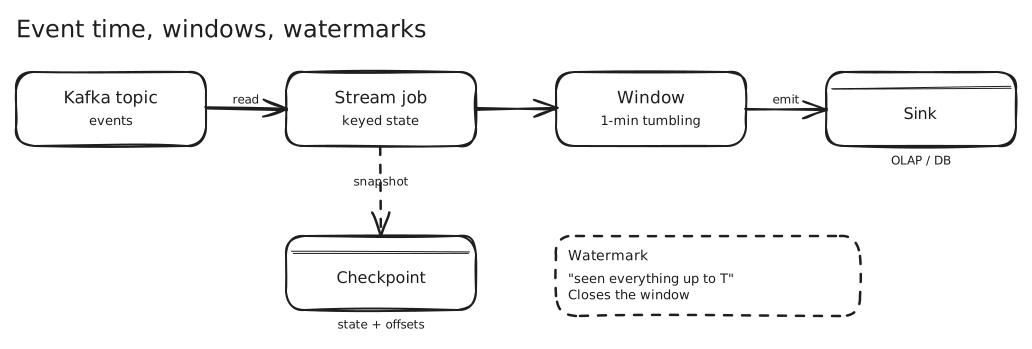
A stream processor (Flink, Kafka Streams, Spark Structured Streaming) reads an unbounded stream of events, keeps state per key, and continuously emits results.
The building blocks
- Source and sink: usually a Kafka topic in, and a database, OLAP store or another topic out. → Kafka
- Keyed state: the job partitions the stream by a key (
ad_id) and keeps per-key state (a counter, a set, a map). All events for one key go to one task, so state is local and fast. - Operators: map, filter, join, aggregate, and window.
- Parallelism: as many tasks as partitions or key groups, spread over workers.
The fact that state lives next to the computation is what makes stream jobs fast, and it’s also what makes recovery the interesting part.
Windows
A running total forever isn’t useful; you want counts per interval.
- Tumbling: fixed, non-overlapping (each minute). The minute view.
- Sliding: a fixed length that advances by a smaller step (the last 10 minutes, updated every minute); windows overlap. “Top 100 ads in the last M minutes.”
- Session: grouped by gaps of inactivity (a user’s visit).
Processing time lies; use event time
If the job lags for four minutes and then catches up, processing time puts the 14:03 clicks into 14:07’s bucket: a dip and a spike that never happened. Bucket by event time (when the click actually happened, carried in the event) and a replayed backlog lands in the right minutes.
Whose clock? A client’s clock can be wrong or hostile. Stamp the event at the first server you control.
Watermarks: when is a window finished?
With event time there’s no moment when you know you’ve seen the last 14:03 event. A straggler may be in a slow network path.
A watermark is the processor’s running estimate: “I’ve now seen everything up to time T”. A window emits when the watermark passes its end. The simplest watermark is bounded out-of-orderness: the latest event time seen minus a fixed allowance (say 15 seconds).
The watermark is a guess, so decide what happens to events after it: drop them, allow lateness (re-emit an updated window), or send them to a side output for a batch job to fix. The batch layer that re-aggregates from raw events is what makes the final number correct. → Ad Click Aggregator
State, checkpoints and exactly-once
A job that crashes loses its in-memory state. So the framework checkpoints: it periodically snapshots operator state together with the source offsets to durable storage. On failure it restores the last checkpoint and rewinds the sources to match, so state and position agree.
That gives exactly-once state updates inside the job. It does not give exactly-once effects on the outside world: a sink that isn’t idempotent (or transactional with the checkpoint) can still see duplicates after a rewind. Make sink writes idempotent, keyed by window and key, or commit them with the checkpoint. → Idempotency
Kafka Streams does the same job differently: state stores are backed by a compacted changelog topic, and recovery replays the changelog. Flink writes snapshots to durable storage.
Hot keys and joins
- Skew: one hot key overloads one task. Do a two-stage aggregation: salt the key (
adId:0..N) for local partial counts, then merge the partials. → Hotspots and Dynamic Resharding - Co-partitioned joins: if two streams are partitioned by the same key with the same partition count, a task can join them locally with no network. That’s how Chat System joins messages with membership.
- Stream-table joins: enrich events from a slowly changing table held as local state (fed by a CDC stream).
Batch, stream, or both?
| Approach | Live counts | Corrections | Logic written |
|---|---|---|---|
| Batch only | a day late | rerun | once |
| Lambda | stream job | batch over raw | twice |
| Kappa | stream job | replay raw through the same job | once |
Lambda’s cost is two implementations that must agree. Kappa needs a replayable log and a replay service. Either way, keep the raw events: a stream count is a fast estimate, and the number that gets billed should be reconciled from raw data.
In an interview
Say event time, watermark and what you do with late events. Say how state survives a crash (checkpoint plus offset rewind). Say whether the sink is idempotent. Then name the hot-key fix.
The trap is describing “Flink” without saying what a window is closed by.
Seen in
- Ad Click Aggregator — tumbling windows, the 15-second watermark, lambda versus kappa, salted hot ads
- News Feed — Kafka Streams state for the follower map, changelog recovery, streaming follower counts
- Chat System — the co-partitioned join of messages and membership
- YouTube Top-K — sliding-window heavy hitters
- Metrics Monitoring — downsampling and alert evaluation over streams
- Twitter Search — the indexing consumers batch and upsert
Related
Event-Driven Architecture · Event Sourcing · CQRS · Message Queues