Stage 03 · Scaling data
Scaling Writes
Reads had a ladder of cheap tricks. Writes don’t: every write must land somewhere durable, in the right order, and you can’t serve it from a cache. When Uber’s ten million drivers report their location every five seconds, that’s two million writes a second, and no read-side trick helps.
Scaling writes is about reducing the cost per write, reducing the number of writes, and spreading what’s left across machines without creating a hot spot.
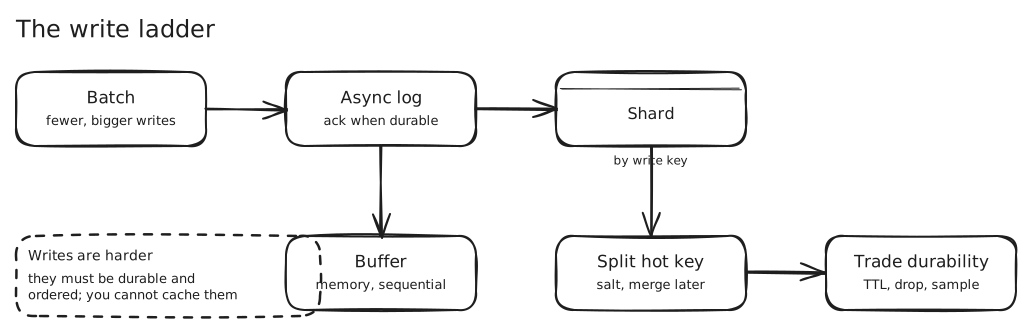
1. Make each write cheaper
- Batch. One request carrying a thousand records is far cheaper than a thousand requests: fewer round trips, less per-request overhead. Elasticsearch wants bulk requests; warehouses want files, not rows.
- Append, don’t update. Sequential appends (a log, an LSM tree) are much faster than random in-place updates. That’s why Kafka and Cassandra take writes so cheaply. → Kafka · Cassandra and DynamoDB
- Don’t do it in the request. Acknowledge once the write is durable in a log, and do the expensive work (indexing, fan-out, notifications) asynchronously. The user needs “we won’t lose it”, not “it’s fully processed”. → Event-Driven Architecture
2. Do fewer writes
- Coalesce. Ten thousand likes on one tweet become one update per batch, keeping only the latest count. A stream job turns a million view events into a few hundred
+Nwrites. - Sample. For popularity and analytics, logging 1 in N events ranks the same. (Never for money.)
- Vary the rate. A parked driver reports every 30 seconds; one on a motorway every 3. Adaptive intervals cut total volume several-fold.
- Skip the write: compute derived data on read when it’s cheap, instead of maintaining it.
3. Trade durability where it’s cheap
Not every write must survive. A driver’s position is worthless in five seconds, and the recovery for a lost one is “the driver pings again”. So put it in memory with a TTL and async replication, and accept losing a few seconds on failover. Compare the ride record, where losing a row loses a customer’s trip. Same system, opposite decisions. → Uber · TTL as a Coordination Primitive
4. Shard the writes
When one node can’t take the rate, split by a write key so each shard sees a fraction. → Sharding and Partitioning
- Choose the key the queries use, not the one that balances load best. Round-robin balances perfectly and makes every read a scatter-gather. Then fix imbalance by splitting, not by changing the key.
- Colocate what’s contended so one node settles a race (shard rides by
rideId, seats byshowId). - Hash or range? Hash spreads evenly; range keeps neighbours together (and a hierarchical range, like H3 cells, splits a hot region with one row swap). → Hotspots and Dynamic Resharding · Consistent Hashing
5. Hot keys need their own fix
Sharding spreads different keys, not one. A viral ad, a celebrity, a hot listing sends all writes to one shard.
- Split the key: write
ad:42:0..N, keep partial counts and merge on read (or in a two-stage stream job). - Batch in front: aggregate in the app or a stream job so the hot key gets one write per second, not ten thousand.
- Move the write off the hot path: append the event to a log (one partition handles 50+ MB/s) and aggregate downstream.
→ Ad Click Aggregator · News Feed
6. Writes that fan out
One logical write that becomes many (a post to a million followers, a message to a group, a permission change on a folder) is the expensive kind. Bound it (a 500-user share cap, a friend cap), switch strategy above a threshold (push for normal accounts, pull for celebrities), or do it lazily. Batch the resulting writes by destination shard and issue them in parallel. → News Feed · Chat System
Correctness when writes go async
Faster writes mean weaker guarantees, so state them.
- At-least-once means duplicates: make the write idempotent (a unique key, a conditional write, an upsert). → Idempotency
- Order the dual writes so the failure is harmless (write the row that grants the right to act first), or use an outbox. → Avoiding Distributed Transactions
- Ordering: keep it per key by partitioning on that key.
In an interview
Give the write rate first, then say which rung you’re on: batch, async log, shard, hot-key fix. Say what you traded for it (durability, freshness, ordering). Name the shard key and the query it serves.
The trap is “shard it” with no key, no hot-key answer and no idempotency story.
Seen in
- Uber — 2M writes/s of disposable location data versus 100/s of precious ride data
- Ad Click Aggregator — Kafka on the write path, salted hot ads, aligned partitions
- Chat System — fan-out on write with a cap, and the large-group switch
- Twitter Search — bulk upserts, one update per tweet per batch
- Metrics Monitoring — batching and downsampling time-series writes
- Gaming Leaderboard — hot sorted sets and score updates
Related
Scaling Reads · Sharding and Partitioning · Message Queues · Event-Driven Architecture